How to set boundaries that protect your energy without isolating your heart
Setting boundaries can feel difficult and alarming. Lots of us don’t quite understand how to do it and believe that setting a boundary is about controlling someone else’s actions towards us. But in reality, a boundary is a meeting point. It is what you are comfortable with.
When you set a boundary, you are not telling someone else how to behave. You are defining how you will care for yourself in their presence. It is a subtle but massive shift in perspective that allows you to remain open-hearted without being hollowed out.
When we want to be our authentic selves, putting up boundaries that feel like walls can feel isolating and uncomfortable. What if the true architecture of authenticity is not about building a fortress but about installing a well-functioning gate?
Let’s explore.

The Difference Between Walls and Gates
I think it helps to think of the purpose of these two structures - a wall is to keep something out while a gate allows something in, when we choose to open it.
Think of a wall as being a reactive structure. It is built in a hurry to stop entry. Because walls lack windows, they block out the sunlight along with the noise. While this can be useful, it feels very permanent and isolating.
A gate, however, is a proactive choice. It allows for a selective exchange of energy. You can choose to open the gate and let all or some of the energy on the other side in. You can close and lock it when you want to, or just open it a crack if you’re feeling cautious.
Characteristics of Internal Structures
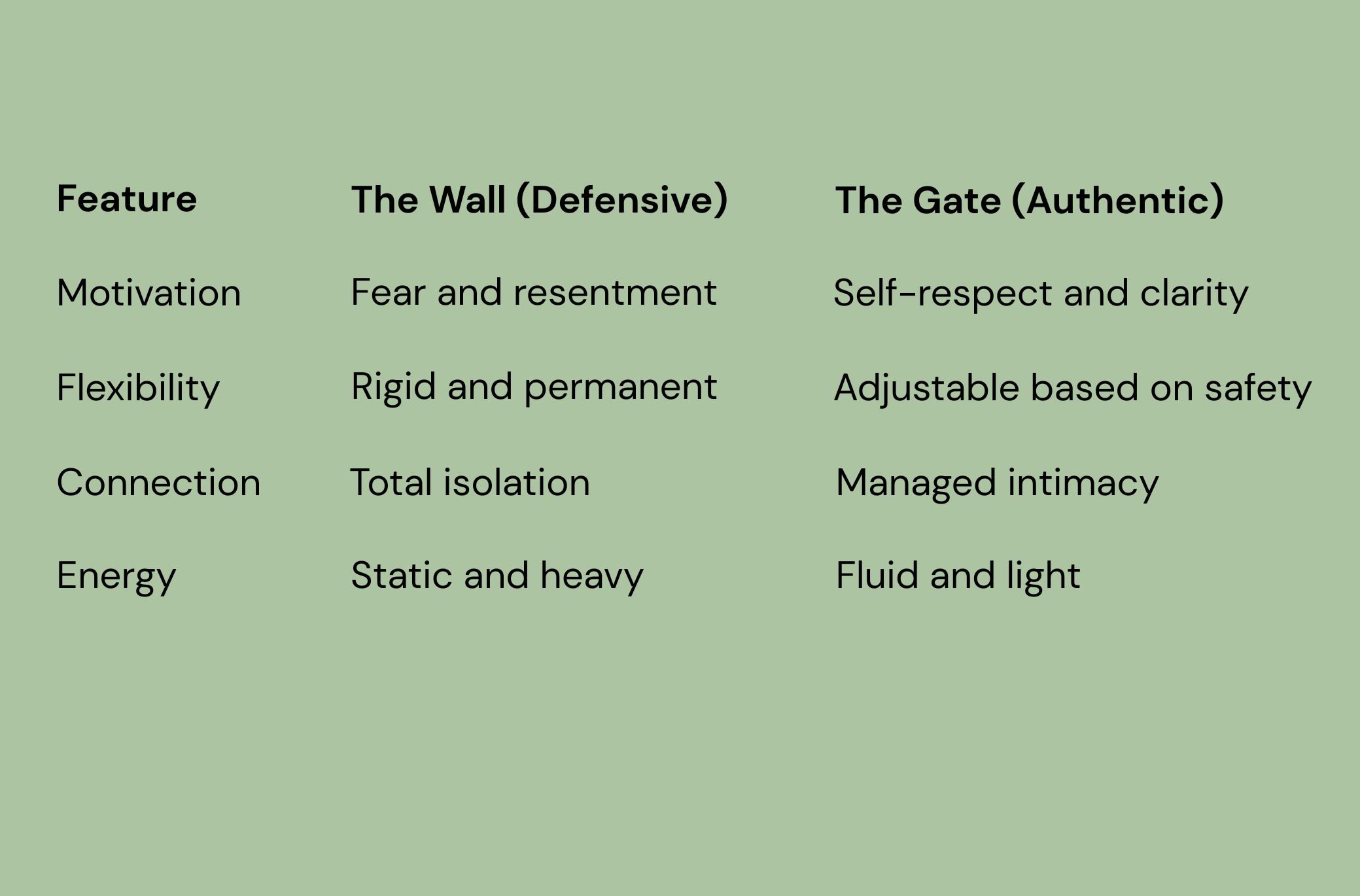
Identifying the Energy Leaks
Protecting your energy requires a high level of self-awareness. You might notice that certain interactions leave you feeling completely wiped out, while others leave you energised.
Authenticity requires you to admit that your capacity is finite. You cannot be everything to everyone and still be something to yourself.
Common areas where energy leaks occur include:
The Emotional Vacuum: Being the default therapist for everyone in your life without reciprocity.
The Time Thief: Saying yes to events or favours because you fear the temporary discomfort of a no.
The Intellectual Drain: Engaging in arguments or explanations with people who have no intention or do not have the capacity to understand you.
How to Stay Warm
The biggest hurdle to setting boundaries is the fear that we will sound cold or clinical. We worry that by protecting our peace, we are hurting our relationships. In reality, a clear boundary is one of the kindest things you can give another person. It removes the guesswork and prevents the slow poison of resentment from ruining the connection. So often when a client sets a boundary, the relationship improves. It is often the ambiguity or mismatch in expectation that is the issue, not the boundary itself.
Instead of using scripted, therapeutic language that feels foreign, use your own voice. The goal is to be firm on the limit but soft on the person.
If a friend constantly calls you to vent during your work hours, a wall would be blocking their number. A gate would be saying: I love hearing from you, but I cannot give you my full attention while I am working. Let’s talk at six when I can fully listen.
This protects your focus while simultaneously honouring the friendship. You are closing the gate for a specific time, not tearing down the path between your houses.
The Art of the Soft Landing
Setting a boundary can of course cause a reaction. It is this that people fear. Some people may feel rejected, and that is okay. You are responsible for the clarity of your communication, but you are not responsible for their emotional processing of your limit. Given time, quite often people come around to a boundary being set. Although it can be very difficult if you have relationships with people who aren’t very emotionally mature, or feel they have ownership over you.
If you find yourself feeling guilty, remind yourself that isolation is the result of hidden resentment. By speaking your truth and setting a boundary, you are actually preventing isolation. You are creating a sustainable environment where your heart can stay involved because it no longer feels threatened.
True authenticity is the ability to stand in your own space, knowing exactly where you end and the rest of the world begins. When the architecture of your life is built on this foundation, you don’t need to hide. You can let the right people in, keep the wrong energy out, and live with a heart that is both protected and profoundly connected.